

Georgetown & North Austin, Texas · Patient Guide
Sleep Apnea & Oral Appliances Near
Georgetown and North Austin: A Practical Guide to Your Options
If you snore loudly, wake up tired no matter how many hours you slept, or have been handed a CPAP machine you can’t bring yourself to wear — you have more options than you might think, and one of them happens at the dentist’s office.
Sleep apnea is one of the most common conditions we never talk about. It hides in plain sight: a spouse who’s been nudged awake by snoring for years, a tired afternoon that’s been quietly normalized, a CPAP unit gathering dust in a closet. For a lot of patients across Georgetown and North Austin, a small, custom oral appliance is the difference between treatment that sits in a drawer and treatment you’ll actually use every single night.
Here’s a plain-language look at what sleep apnea is, where dentistry fits, and what to look for before you commit.
What sleep apnea actually is — and why it’s worth taking seriously
Obstructive sleep apnea (OSA) happens when the soft tissues at the back of the throat relax during sleep and collapse the airway. Breathing slows or stops for seconds at a time, oxygen dips, and the brain briefly rouses you just enough to reopen the airway — often without your ever remembering it. This can repeat dozens, sometimes hundreds, of times a night.
The symptoms most people notice are loud snoring, gasping or choking sounds during sleep, and waking up unrefreshed. The quieter ones matter just as much: morning headaches, daytime fatigue, brain fog, irritability, and trouble concentrating. Frequently it’s a bed partner who raises the alarm first.
What makes OSA worth treating isn’t the snoring. Untreated sleep apnea is associated with higher blood pressure, heart disease, stroke, type 2 diabetes, and the kind of chronic daytime drowsiness that makes driving genuinely dangerous. It’s a medical condition with a comfortable, manageable fix — which is exactly why it’s frustrating to leave untreated.
First, an honest word: a dentist doesn’t diagnose sleep apnea
This is the part that gets glossed over, so we’ll say it plainly. Sleep apnea is diagnosed by a physician, based on a sleep study — either an in-lab test or a home sleep test you can do in your own bed. A dentist can’t diagnose it, and you should be wary of any dental office that claims otherwise.
What a good dental sleep practice does is work alongside your physician. If you’ve never been tested, we’ll screen for the warning signs and help coordinate a referral for a sleep study. Once OSA is confirmed and a doctor signs off on oral appliance therapy as appropriate for you, that’s where dentistry comes in — designing, fitting, and fine-tuning the device. If you’ve already been diagnosed (and especially if you already have a CPAP you can’t tolerate), you can come straight in to talk about an appliance.
You can read how the team approaches this coordinated model on the sleep apnea treatment page.
CPAP works — when people can actually stick with it
Let’s be fair to CPAP. Continuous positive airway pressure is the gold-standard treatment for moderate-to-severe sleep apnea, and for many people it’s life-changing. If your CPAP works and you wear it, keep wearing it.
The problem is adherence. A large share of patients struggle with the mask — it feels claustrophobic, it’s noisy, it dries out the mouth and nose, it complicates travel, or it simply ends up shoved in a nightstand within the first year. And a CPAP that isn’t worn treats nothing. A patient who quietly abandoned their machine three years ago is, medically speaking, back to square one.
That’s the gap an oral appliance is designed to fill — not to compete with a CPAP that’s working, but to be a treatment you’ll genuinely use when CPAP isn’t the answer.
What an oral appliance does — and what to look for
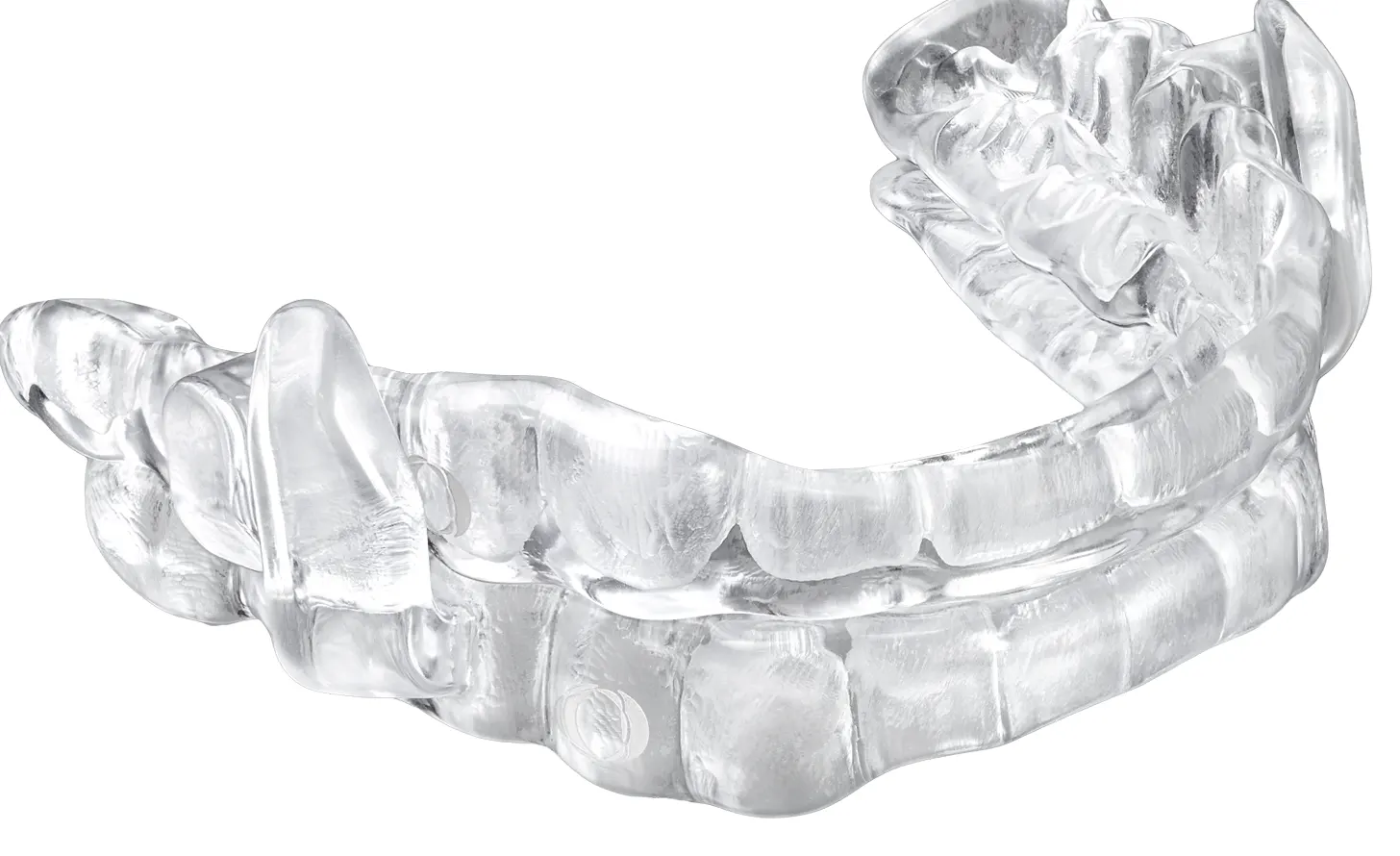
A dental sleep device looks a lot like a sturdy mouthguard or a clear retainer, and it’s worn only while you sleep. There’s no mask, no hose, no machine, no electricity, and nothing to pack a power supply for when you travel. Here’s how to think about it.
01How it works
Most dental sleep devices are mandibular advancement devices. They gently hold your lower jaw slightly forward, which keeps the soft tissue at the back of the throat from collapsing and keeps the airway open. That’s the entire mechanism — position the jaw, protect the airway. For many patients with mild-to-moderate OSA, and for those who can’t tolerate CPAP, it’s remarkably effective for how simple it is.
02Custom and adjustable beats off-the-shelf
The drugstore “anti-snoring” mouthpieces and boil-and-bite kits are a different category entirely. A medical-grade oral appliance is made from precise impressions or a digital scan of your teeth, fits your bite exactly, and — crucially — is adjustable. The forward position of the jaw can be dialed in over several visits until your sleep improves and the device stays comfortable. That adjustability is most of what you’re paying for.
03Coordination with your sleep physician
The best outcomes come from a dentist and a sleep physician working from the same playbook: the physician confirms the diagnosis and severity, the dentist builds and titrates the device, and in many cases a follow-up sleep test confirms the appliance is doing its job. Ask whether a practice routinely works this way. A standalone “snore guard” with no physician in the loop is a red flag.
04Follow-up, fit, and a location you’ll actually return to
An oral appliance isn’t a one-and-done. Expect a few visits to adjust it, plus periodic check-ins to confirm the fit and check on your bite over time. That makes proximity practical, not cosmetic — a practice you can reach easily from Georgetown or North Austin is the one you’ll keep going back to. Hammons Family Dental’s Georgetown office sits just off Williams Drive, a straightforward drive up I-35 from the North Austin corridor.
Who oral appliance therapy tends to suit
It isn’t right for everyone, and a good practice will tell you so. As a general guide, oral appliances are most often considered for:
Patients with a confirmed diagnosis of mild or moderate obstructive sleep apnea are frequently good candidates for a custom oral appliance as a first-line treatment.
If you’ve tried CPAP and genuinely can’t stick with it, an appliance is often the most realistic path to consistent, nightly treatment — the kind that actually protects your health.
A device that fits in a small case with no machine, hose, or power supply is far easier to keep using on the road, in an RV, or at a grandchild’s house for the weekend.
For disruptive snoring or upper-airway resistance that falls short of full-blown apnea, an appliance can meaningfully quiet the night — though testing still comes first to rule out something more serious.
Some patients use an appliance alongside CPAP, allowing a lower, more tolerable pressure setting. This is decided with your sleep physician based on your test results.
A note on insurance — sleep devices are usually medical, not dental
This trips up a lot of people, so it’s worth knowing up front: oral appliance therapy for diagnosed sleep apnea is typically billed to your medical insurance, not your dental plan. Medicare and many medical plans cover it when the criteria are met — a documented diagnosis, a qualifying sleep study, and a prescription. The requirements and paperwork are specific, which is one more reason to choose a practice that handles dental sleep medicine routinely and knows how to document it correctly.
It’s a fair question to ask before you book: Do you bill medical insurance for oral appliances, and can you tell me what my plan is likely to cover?
Getting Here
Hammons Family Dental — Georgetown
The short version
If you snore, wake up tired, or have walked away from a CPAP you couldn’t tolerate, don’t write off treatment — talk to a dentist who practices sleep medicine. The right approach is honest about its limits (a dentist coordinates with your physician, who makes the diagnosis), uses a custom, adjustable appliance rather than a drugstore mouthpiece, follows up to get the fit right, and is close enough to home that the follow-ups never become a hassle.
For patients in Georgetown and North Austin, Hammons Family Dental offers sleep apnea treatment built around exactly that model — custom oral appliances, fitted and adjusted in-house and coordinated with your sleep physician, just off Williams Drive in Georgetown.
Tired of being tired?
Book a sleep appliance consultation online in under a minute, or call our Georgetown office during regular hours.
About Hammons Family Dental Led by Dr. Travis Hammons — a University of the Pacific honors graduate, U.S. Army veteran, and member of the American Dental Association and Texas Dental Association — Hammons Family Dental serves patients across Georgetown and North Austin from its office at 1502 Blue Ridge Drive, Suite 101 in Georgetown. The practice offers dental sleep medicine and oral appliance therapy in coordination with patients’ sleep physicians. Meet the doctors to learn more about the team.
Related: sleep apnea treatment · our North Austin office