

Georgetown & North Austin, Texas · Patient Guide
Implant-Supported Dentures vs. Traditional Dentures:
An Honest Comparison for Georgetown and North Austin
If you’re facing the loss of most or all of your teeth — or you’ve worn dentures for years and quietly stopped ordering steak at restaurants — you’re standing at one of the biggest decisions in dentistry. Here’s the comparison nobody gives you straight.
Replacing a full arch of teeth comes down to two main paths: a traditional removable denture, or a set of replacement teeth anchored to dental implants — often called All-on-X, All-on-4, or implant-supported dentures. Both are legitimate options. Both have trade-offs. And the marketing around this topic tends to be so one-sided, in one direction or the other, that patients across Georgetown and North Austin end up making a major decision with half the picture.
So here’s the whole picture, in plain language: how each option actually works, where each one wins, and how to figure out which is right for you.
How each option works
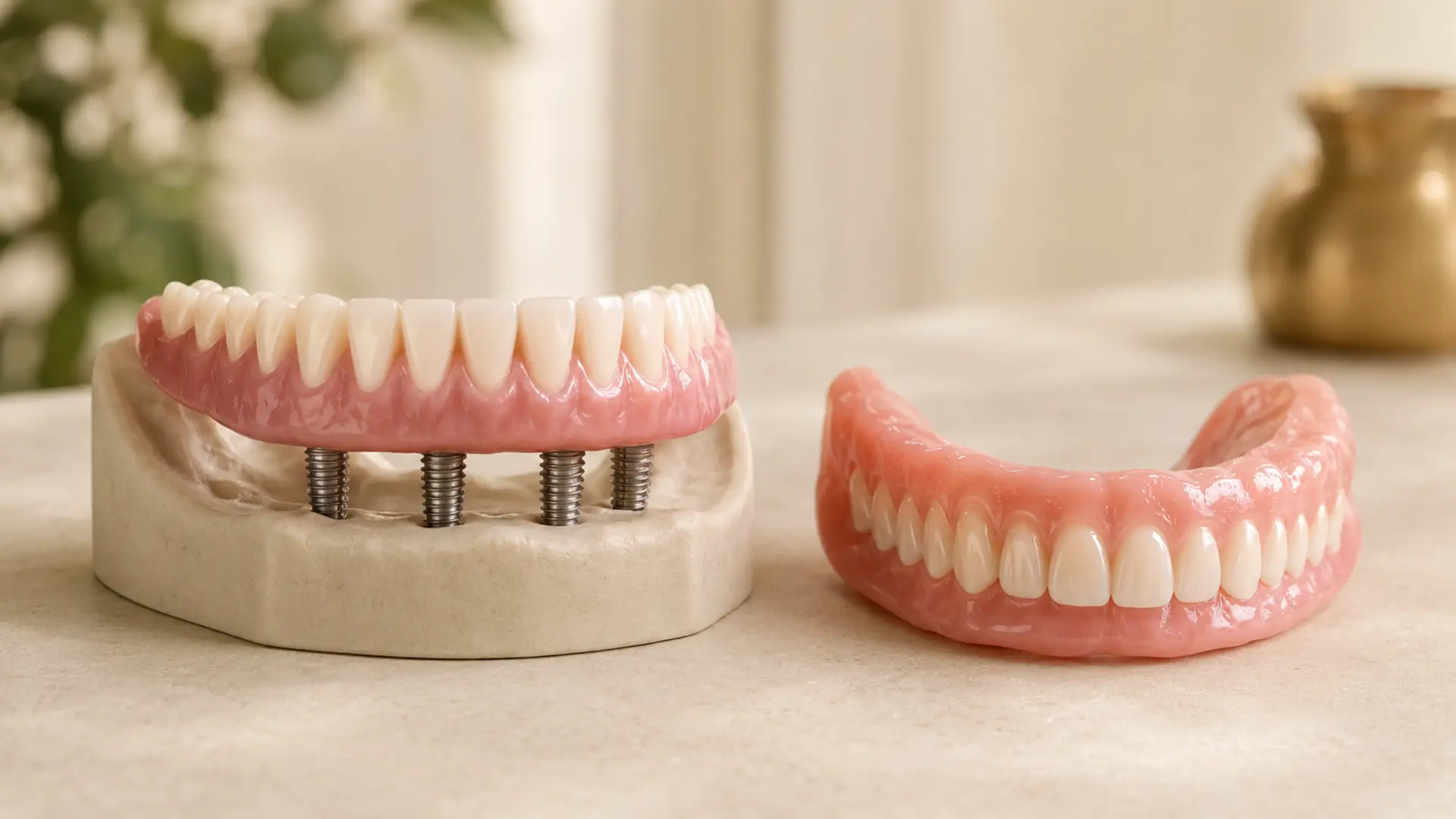
A traditional denture is a removable set of replacement teeth that rests on your gums, held in place by suction, the shape of your ridge, and sometimes adhesive. It comes out at night for cleaning. Modern dentures are far better fitting and better looking than the ones your grandparents wore — this is not a bad option, and for many patients it’s the right one.
An All-on-X implant-supported denture takes a different approach: a small number of dental implants — typically four to six titanium posts per arch — are placed in the jawbone, and a full arch of replacement teeth is secured to them. Depending on the design, the arch is either fixed in place (only a dentist removes it) or snaps on and off for cleaning. Either way, the teeth are anchored to bone, not resting on gum.
That single difference — resting versus anchored — drives almost everything else in this comparison.
The honest comparison, point by point
01Stability and eating
This is where implant-supported dentures win decisively. A traditional denture restores only a fraction of natural biting force, which is why long-time denture wearers drift toward softer foods and cut everything small. The lower denture is the usual troublemaker — the tongue and jaw movement work against suction all day. Implant-anchored teeth restore chewing power close to natural teeth: corn on the cob, apples, a good steak, all back on the menu, with no slipping mid-sentence and no adhesive.
02Bone health — the part nobody mentions
Here’s the quiet, important one. Your jawbone stays healthy because tooth roots stimulate it every time you chew. Remove the roots and the bone slowly resorbs — it’s why long-time denture wearers develop that sunken facial appearance, and why dentures that fit well at first need relining and remaking as the ridge shrinks underneath them. Implants act like artificial roots: they transmit chewing forces into the bone and help preserve it. A traditional denture can’t do this. If you’re deciding at 60, this is a question about what your jaw — and your face — look like at 75.
03Daily life and maintenance
Traditional dentures mean a nightly routine: out, cleaned, soaked, back in each morning, adhesive as needed, periodic relines as the fit changes. Implant-supported teeth are closer to caring for natural teeth — brushing, cleaning around the implants, regular checkups — with no adhesive and no cup on the nightstand. The honest counterpoint: implant-supported arches demand good hygiene. The implants can’t decay, but the gums around them can get infected if neglected, and that’s the main way implant cases fail.
04Cost and timeline
No way around it: traditional dentures cost significantly less up front and are finished in weeks, while All-on-X is a major investment involving surgery, healing time, and months from start to final teeth. But the honest math is lifetime math. Dentures need relines and periodic replacement, plus years of adhesive; implants, well cared for, are built to last decades. Neither option is “cheap” over 20 years — they’re different payment shapes for solving the same problem, which is why the financial conversation belongs in the consultation, in real numbers, not in a blog’s vague ranges.
Who tends to choose which
There’s no universally “best” answer — there’s a best answer for your mouth, your health, your budget, and your priorities. As a general guide:
Patients who’ve tolerated a loose lower denture for years are often the happiest All-on-X patients of all — even a snap-on implant denture with two to four implants is a dramatic upgrade in stability.
If your remaining teeth are beyond saving, going straight to an implant-supported arch preserves the most bone — the earlier implants are placed after tooth loss, the better the foundation.
If eating what you want, when you want, without thinking about it is a top-three priority for you, implants are the option built for that life.
A well-made traditional denture or partial restores a complete, natural-looking smile at a fraction of the cost — and can be designed so implants can be added later.
Implants require adequate bone and reasonable healing capacity. Some medical conditions, medications, and heavy smoking change the calculus — an honest exam tells you where you stand.
An honest word: not everyone is an implant candidate on day one
Any practice that tells every patient “you’re a perfect candidate” before looking at a 3D scan isn’t evaluating you — it’s selling to you. Implant success depends on bone volume, gum health, and overall health, and the only way to know is imaging and an exam. The good news: modern techniques mean far fewer people are ruled out than a decade ago, and “not yet” often just means bone grafting or treating gum disease first. What you deserve is a straight answer about your specific situation — including, sometimes, “a traditional denture is genuinely your best option, and here’s why.”
A note on cost and financing — ask before you assume
Sticker shock keeps a lot of people from even asking about implants, which is a shame, because the consultation is where real numbers replace internet guesses. Dental insurance often contributes toward portions of treatment, financing spreads the investment into monthly terms many patients find manageable, and our in-house dental plan and financial options can help patients without insurance. And if the numbers ultimately point to a traditional denture, we’ll make you an excellent one. The goal is teeth you can live with — not a particular product.
Quick answers: implant-supported dentures in Georgetown & North Austin
Q.What is the difference between All-on-X and traditional dentures?
A traditional denture rests on your gums and comes out at night. An All-on-X denture is anchored to four to six dental implants in the jawbone, so it stays put, chews close to natural teeth, and helps preserve the bone underneath.
Q.How many implants do implant-supported dentures need?
Typically four to six implants per arch for a fixed All-on-X restoration. Some snap-on implant dentures work with as few as two to four implants — your bone volume and goals determine the right design, which is why treatment starts with 3D imaging.
Q.How much do All-on-X dentures cost in Georgetown, TX?
Cost varies significantly with the number of implants, the type of restoration, and any preparatory work, so the honest answer comes from a consultation with 3D imaging. Insurance often contributes, and financing and our in-house dental plan can help make treatment manageable.
Q.Am I a candidate for implant-supported dentures?
Most healthy adults with adequate jawbone are candidates, and modern techniques rule out far fewer people than a decade ago. “Not yet” often just means bone grafting or gum treatment first. A 3D scan and exam gives you a straight answer about your situation.
Q.Do implant-supported dentures prevent bone loss?
They help significantly. Implants act like artificial tooth roots, transmitting chewing forces into the jawbone and stimulating it — which traditional dentures can’t do. That’s why implant patients avoid much of the bone shrinkage and facial change long-time denture wearers experience.
Getting Here
Hammons Family Dental — Georgetown
The short version
Traditional dentures are the more affordable, faster path to a complete smile, and modern ones are genuinely good. Implant-supported dentures cost more and take longer, but they chew like real teeth, stay put, preserve your jawbone, and are built for decades. The deciding factors are your bone, your health, your priorities at the dinner table, and your budget over twenty years — not five. The right way to decide is a 3D scan, an honest exam, and real numbers side by side.
For patients in Georgetown and North Austin, Hammons Family Dental offers exactly that conversation — All-on-X implant-supported dentures, dental implants, and quality traditional dentures, with 3D imaging on site and a recommendation based on your mouth, not a sales quota.
Find out what your options really are.
Book a consultation online in under a minute — 3D imaging, an honest evaluation, and a side-by-side of your options with real numbers.
About Hammons Family Dental Led by Dr. Travis Hammons — a University of the Pacific honors graduate, U.S. Army veteran, and member of the American Dental Association and Texas Dental Association — Hammons Family Dental serves patients across Georgetown and North Austin from its office at 1502 Blue Ridge Drive, Suite 101 in Georgetown. The practice offers All-on-X implant-supported dentures, dental implants, and traditional dentures, with 3D imaging and treatment planning on site. Meet the doctors to learn more about the team.